<?xml version="1.0" encoding="utf-8"?>
<feed xmlns="http://www.w3.org/2005/Atom">
  <title>On The Terraces</title>
  <subtitle></subtitle>
  <link href="https://ontheterraces.co.uk/feed.xml" rel="self"/>
  <link href="https://ontheterraces.co.uk/"/>
  
    <updated>2019-11-20T00:00:00Z</updated>
  
  <id>https://ontheterraces.co.uk</id>
  <author>
    <name>Alan Hylands</name>
    <email>alan@alanhylands.com</email>
  </author>
  
    
    <entry>
      <title>George Best: Where Did It All Go Wrong?</title>
      <link href="https://ontheterraces.co.uk/george-best-where-did-it-all-go-wrong/"/>
      <updated>2005-11-21T00:00:00Z</updated>
      <id>https://ontheterraces.co.uk/george-best-where-did-it-all-go-wrong/</id>
      <content type="html">
        <![CDATA[
      <p><img src="/images/George_Best_(1976).jpg" alt="George Best playing for Northern Ireland in 1976"></p>
<p>George Best was born on the 22nd of May 1946 to a working class Protestant family in post-war Belfast, Northern Ireland.</p>
<p>Those inauspicious surroundings in the terraced streets of his home city gave little indication that the young George would go on to become one of the world's most famous, and ultimately infamous, sporting heroes.</p>
<p>Little indication, that is, unless Best had a football at his feet.</p>
<p>He was spotted at age 15 by Manchester United scout Bob Bishop and given a trial in 1961, alongside fellow Belfast boy Eric McMordie. George almost never made it at all, feeling homesick after only 24 hours at Old Trafford and returning home to Belfast.</p>
<p>His father Dickie knew what he was giving up though and intervened by phoning Matt Busby himself, asking if the skinny young boy from Belfast could be given another chance. Busby agreed. Best was back in Manchester within a fortnight and the rest, as they say, is history.</p>
<h3>Turning Pro</h3>
<p>Best turned professional in 1963 and made his debut that autumn as a 17 year old  at home to West Bromwich Albion. A couple of months later, still feeling homesick, he returned to Belfast to spend Christmas with his family, but received word that United needed him to play against a Burnley side who had thrashed them 6-1 at Turf Moor on Boxing Day.</p>
<p>He agreed to come back as long as the club flew him to Manchester then flew him back to Belfast immediately after the match. They agreed and George Best began to see just how much Manchester United valued him, even as a 17 year old with only one league game under his belt. Best scored his first goal for United in a thrilling 5-1 victory and found himself a starting member of the team.</p>
<h3>Establishing himself as a new Busy Babe</h3>
<p>The following year Manchester United finished second in the League, reached the semi-finals of the FA Cup and the quarter-finals of the European Cup Winners' Cup. This was their first season back in Europe since the Munich disaster of 1958 and the lingering after-effects of the tragedy still hung over the club like a black cloud.</p>
<p>Best was ably assisted by Bobby Charlton and Denis Law in the United side, and the &quot;Holy Trinity&quot;, above all others, would help propel the club away from the spectre of the lost Busby Babes and into a bright new future.</p>
<p>The expectation levels surrounding George were growing ever stronger. He was more than up to the challenge though, displaying the skill, flair and panache, both on and off the pitch, which would lead him to be dubbed &quot;the fifth Beatle&quot; because of his popularity and his fashionable mop top hairstyle.</p>
<p>As he lead Manchester United to the league title in 1965 on the field, Best was increasingly in demand off it as well. Regular modelling assignments and opening his own fashion boutique were only the tip of the commercial iceberg for football's first real fashion icon.</p>
<h3>The legend of El Beatle is born</h3>
<p>After the exertions of that Championship year, United started the following season poorly and Best found himself dropped from the side. He recovered, and in one of the most memorable matches ever in European club football, inspired Manchester United to a 5-1 victory against the seemingly invincible Benfica in the Stadium of Light.</p>
<p>Best's season wasn't to get any better though as he damaged his knee cartilage in the European Cup semi-final and missed the rest of the season. The legend of &quot;El Beatle&quot; wasn't so easy to put down though.</p>
<p>The following season of 1966/67 was free of European worries for United and they welcomed Best back from injury to feature now on the right hand side of their attack. They won the title in style and catapulted themselves back into the race for Matt Busby's Holy Grail, the European Cup.</p>
<h3>European Glory</h3>
<p>Fielding arguably the greatest side in United's history, they fought their way to the final at Wembley in 1968. In an epic encounter against old foes Eusebio's Benfica, United ran out 4-1 winners in an unforgettable display of footballing skill and passion. Best scored one and was crowned European Footballer Of The Year.</p>
<p>This was George Best at the peak of his powers. At the age of just 22, he had won the English league title, the European Cup, and been named European Player of the Year.</p>
<p>Best had the world, literally, at his feet.</p>
<p>Even he couldn't have believed it would all start going wrong so quickly after the greatest footballing night of his career.</p>
<h3>The downward slope</h3>
<p>He was sent off for fighting against Estudiantes in the Intercontinental Cup, and the following season United struggled badly in the league, finishing a lowly eleventh.</p>
<p>Matt Busby retired and was replaced first by Wilf McGuinness and then by Frank O'Farrell. With his father figure gone, George began drinking more and, for the first time, letting it affect his training and football career.</p>
<p>His nocturnal habits and his fondness for the high life were the stories being printed in the papers as the 1970s began, not footballing ones, and George's interest in football almost disappeared completely.</p>
<h3>The beginning of the end</h3>
<p>He left, then rejoined, Manchester United in 1973 but couldn't motivate himself, and eventually took his talents off for brief spells at Stockport County, Bournemouth, Fulham, Hibernian, Los Angeles Aztecs, Cork Celtic, Fort Lauderdale Strikers, San Jose Earthquakes, Dunstable Town and Brisbane Lions.</p>
<p>Best wasn't even thirty years old when he gave up serious football in pursuit of the bottom of a bottle.</p>
<p>He turned out 37 times for Northern Ireland, some of them running teams ragged on his own, many where he didn't seem interested at all, although throughout it all he maintained  the love of a nation who were always susceptible to his cheeky grin and self deprecating honesty and humour.</p>
<h3>A legend with the ladies</h3>
<p>George was married twice, first to the mother of his son Callum, and then to Alex, who he divorced towards the end of his life. He was, of course, a legendary womaniser who frequently consorted with movie stars and Miss Worlds. That reputation caused him no shortage of problems, both with the other ladies in his life and sometimes the police as well.</p>
<p>George Best was a legend on the pitch, a footballing one-off whose flame shined so brightly for such a short amount of time. We can't help but look back on the wonderful things he did in the game without asking the immortal question &quot;what if?&quot;</p>
<p>His larger than life persona, and off the field indiscretions, kept him in the public eye over the years. But it should never be forgotten that it was his unique talent that set him apart from the rest of his generation.</p>
<h3>&quot;There will never be another George Best&quot;</h3>
<p>Football writers are constantly tagging bright new prospects as &quot;the new George Best&quot;, especially if they happen to come up through the ranks at Manchester United. This has done a great disservice to many young players such as Lee Sharpe, Keith Gillespie and Ryan Giggs over the years.</p>
<p>In truth, there will never be another George Best. In all areas of his life he was one of a kind, both in footballing brilliance and human frailty. A world renowned footballing talent who, sadly, also fought a life-long battle against the destructive disease of alcoholism.</p>
<h3>A sad end</h3>
<p>While I knew George was very ill when I wrote this article, I didn't realise just how little time he had left. George Best died on 25th November 2005 at the tragically young age of 59.</p>
<p>Northern Ireland, and his home city of Belfast, subsequently came to a standstill for his public funeral, allowing his many thousands of fans to grieve alongside the Best family.</p>
<p>Northern Ireland's Belfast City Airport was subsequently renamed &quot;George Best Belfast City Airport&quot; in honour of Belfast's most famous son.</p>
<p>Rest in peace Georgie.</p>
<h3>Gone but never forgotten.</h3>
<p>How then to  sum up the man described by Pele and Diego Maradona as the greatest footballer who ever lived?</p>
<p>We have to recount the often-told, never substantiated though completely believable, anecdote about George and the hotel bellboy who, upon entering Best's hotel room to find him in bed with a magnum of champagne, thousands of pounds in cash from a winning night at the casino and the current Miss World, remarked, &quot;George, where did it all go wrong?&quot;</p>
<h3>Where indeed...</h3>

    ]]>
      </content>
    </entry>
  
    
    <entry>
      <title>I Want To Be A Football Writer When I Grow Up</title>
      <link href="https://ontheterraces.co.uk/i-want-to-be-a-football-writer-when-i-grow-up/"/>
      <updated>2018-08-09T00:00:00Z</updated>
      <id>https://ontheterraces.co.uk/i-want-to-be-a-football-writer-when-i-grow-up/</id>
      <content type="html">
        <![CDATA[
      <p><img src="/images/world-cup.jpg" alt="The FIFA World Cup trophy being help up"></p>
<h2>Chasing my writing dream, catching it...and letting it go.</h2>
<h3>I blame The Sun newspaper.</h3>
<p>My dad usually bought The Sun.</p>
<p>Occasional dalliances with the Mirror or (worse) the Daily Star but his main paper of choice while I was growing up was The Sun.</p>
<p>This was during the '80s and '90s which was very much pre-internet days.</p>
<p>No forums, no message-boards, no Twitter, no Facebook. If you wanted football news (and which self-respecting football mad kid didn't?), you had two choices.</p>
<h3>The internet - before the internet</h3>
<p>First was Ceefax and Teletext. (For the younger reader, these were like the internet - on your telly). Short news articles would keep you up to date with general goings on. But best of all was the page of one liner adverts for the Clubcall and Teamtalk phone-lines.</p>
<p>These were premium rate phone lines with pre-recorded messages, updated on a daily basis, giving “behind the scenes” info and gossip on your favourite club.</p>
<p>On the Teletext page they would list half a dozen clubs with a teaser headline to get people to call in and ruin their parents' phone bill.</p>
<p>I had no chance of getting sign off from my folks to actually phone them. So I had to make do with sitting in front of the TV, waiting on the Teletext pages to turn, to see if there was any mention of Spurs.</p>
<p>Something similar to the way we check our phones for transfer gossip and news these days so it definitely foreshadowed that kind of addictive behaviour. <strong>It was a simpler time.</strong></p>
<h3>The daily rags</h3>
<p>The second source was the <strong>tabloid newspapers</strong> which, in my case, was The Sun. They had interviews, columns with big name former players and managers and, best of all, transfer gossip. What really piqued my interest in becoming a football writer was the Goals supplement in Monday's paper. The traditional round-up of match reports of all of the weekend's games.</p>
<p>In my younger days I would religiously read every word and keep a record of the match ratings. When Fantasy Football launched in the UK in the mid-90s I was like a moth to a flame. Football <strong>AND</strong> stats – what wonders we were provided with!</p>
<h2>Dreaming of North London...sitting in south Belfast.</h2>
<p>When I got to university I found myself slogging through an Accounting degree I had zero interest in pursuing once I graduated. I would buy the paper on a Monday lunchtime and sit in McDonald's over a Big Mac meal (I had a much faster metabolism then, don't judge me). There I would pore over the match reports as if I had actually been at the games.</p>
<p>I decided then that being a football writer must be the best job in the world. Unfortunately for me I was stuck studying accounting and getting increasingly depressed over the possible paths in front of me.</p>
<p>I didn't pursue journalism or writing when I graduated in 2000. Instead I:</p>
<ul>
<li>Was on the dole for a while.</li>
<li>Played guitar in a band and dreamed of becoming Slash (forewarning: I didn't become Slash).</li>
<li>Worked at the lowest rung of the Civil Service filing paperwork and leading a small mutiny against the conditions and workload expected of my grade. Yeah, we lost that too but I was bored and aimless.</li>
<li>Then I got into a graduate bootcamp to fast-track into IT and actually found a career path I enjoyed.</li>
</ul>
<p>It wasn't until 2005 that I decided to do something about becoming a football writer.</p>
<h2>The rise of blogging and SOTG is born.</h2>
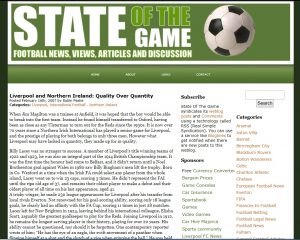
<p>Blogging as an activity (and an occupation) was just breaking into the mainstream and I wanted in on it. I still sat and chatted (mostly) rubbish about football every day with friends and on internet forums so I figured why shouldn't I write about football?</p>
<p>Those hazy days sat in Mickey D's in Shaftesbury Square in Belfast reading the match reports came back to me. So I registered a domain name, read about some new blogging software called Wordpress and away I went.</p>
<p><strong>StateOfTheGame.co.uk</strong> was born.</p>
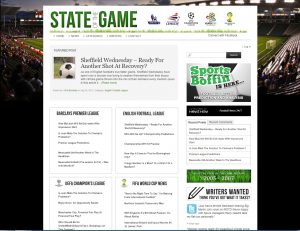
<p><img src="/images/sotg2006-300x240.jpg" alt="State Of The Game in 2006"></p>
<p>I roped in some friends to write and we got cracking. Whatever came into my head on football related topics went into the text box and was published and…<strong>crickets.</strong></p>
<p>It took a while to get up and running but once we got to a few hundred readers a day it started to snowball.</p>
<p>I had grand visions of being a football investigative journalist (from the comfort of my bedroom in rural Northern Ireland). What people really wanted to read though was transfer gossip and shock jock-style over-the-top opinion pieces. Plus ca change.</p>
<p>We built up a good following over the next couple of years, peaking on the day Tevez and Mascherano signed for West Ham. I wrote an opinion piece which got to the top of Newsnow's football page and the site had 19,000 visitors that day.</p>
<p>While the comments were going mad I was on a building site cleaning cement and plastic protective covers off new build house windows. The rock n' roll lifestyle of the football writer.</p>
<h3>Football is a team game</h3>
<p>I wasn't a lone wolf by this time. I made a conscious effort to give young writers a platform to get started by guest posting and running their own regular columns. Looking back, that's one of my best memories.</p>
<p>Many of our old writers went on to have professional football writing careers for papers and blogs and it's a source of great pride to have helped give them even the smallest of openings to help them along the way.</p>
<p>My own writing “career” was ticking along nicely in terms of having a platform. But the small ad revenue the site was bringing in barely covered hosting costs and the building sites weren't great places to hang about on when it got colder.</p>
<h2>Writing For Other Websites - And Getting Paid.</h2>
<p>When prominent bloggers Jeremy Wright, <a href="https://problogger.com">Darren Rowse</a> and Duncan Riley joined forces to create b5media, I paid close attention. They got VC funding for their own blog network and began hiring writers. So I applied.</p>
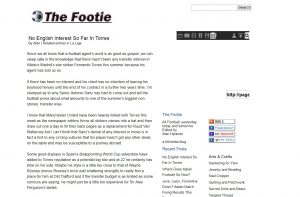
<p>I spoke to Jeremy on Skype, told him my football writing background and why I would be a good fit. He gave me a gig on one of their sites, (imaginatively titled) The Footie. My first paid football writing job, hurrah!</p>
<p><img src="/images/ash_thefootie_b5media-300x197.jpg" alt="The Footie"></p>
<p>I kept SOTG going while I wrote for The Footie and let some of the other writers pick up the pace there. While the pay was small and revenue share-based, it did feel like validation on some level that I had shown I was a competent writer. Imposter syndrome be gone. Someone believed I knew what I was talking about!</p>
<p>The money situation was getting to be a concern however. I was self-employed at the time and a part-time software development job had fallen through when the company went bust. So I needed more cash coming in to pay the bills. And quickly.</p>
<h2>Chasing the corporate dollar and joining the big leagues.</h2>
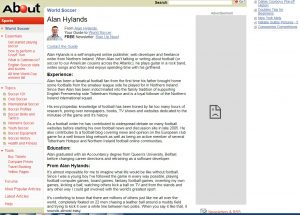
<p>I had no intention of following the starving artist trope in real life. So I was rather excited when I saw a position for World Soccer Guide open up at one of the web's most visited websites, About.com.</p>
<p>For those too young to remember About.com: there were Guides on virtually every topic under the sun, from photography to martial arts to travel to foreign language. They had a massive network effect and top search rankings on nearly every keyword so it really was a prime spot to get into.</p>
<p>Added to that, they were owned by the <strong>New York Times Company</strong>, which gave a little CV kudos that needs no further explanation.</p>
<p>So I applied and jumped through some hoops. And with the industry validation of running and writing a lot for my own football site behind me, along with writing for b5media, I got the job.</p>
<p><img src="/images/ash_aboutdotcom-300x215.jpg" alt="World Soccer Guide at About.com"></p>
<h3>Rolling that boulder up the hill.</h3>
<p>The previous material under your chosen topic was scrubbed from existence and you started with a blank slate. Great in one way. Not so great in another.</p>
<p>The previous World Soccer Guide had built up to a massive crescendo after the 2006 World Cup when his traffic stats had been through the roof.</p>
<p>About.com gave new guides an initial grace period where they paid you a set fee per month to get you going. After that, your pay all depended on a rather complex formula based on growth over the previous year's traffic. So I was starting from a zero base and trying to get as much content written and uploaded to pad out my site. All while spinning up traffic versus numbers from the most visited site in the world during the biggest football event ever. If Sisyphus springs to mind, you'd be getting close to the task at hand.</p>
<h2>The beginning of the end.</h2>
<p>In the beginning I was well into it. SOTG had slowed down as I concentrated my time on About.com. But banging out the quantity of material needed across the whole football spectrum was taking it's toll. I was losing interest in the game itself and the ever-increasing banality of rich clubs fighting it out between themselves in ever decreasing numbers.</p>
<p>After 6 months or so the money situation caught up with me and I took a six month contract as a data analyst just to keep the lights on. Nearly twelve years later I'm still there...</p>
<p>Ultimately the thrill of getting a monthly pay cheque from the New York Times Company decreased while the time I had to keep on the hamster wheel of content production dropped to nearly zero. So I resigned.</p>
<p>SOTG got shuttered. I left b5media and that was the end of my football writing career. Disillusioned, burnt out and barely interested in even watching a game on TV. Not quite what I expected when I was a kid dreaming of it.</p>
<h2>A phoenix from the flames.</h2>
<p>Fast forward four years to 2011.</p>
<p>I'd been re-invigorated and was back in the wider football world. This time I was building a football betting prediction and analysis engine, called Sports Boffin.</p>
<p><img src="/images/sportsboffin-300x199.jpg" alt="Sports Boffin"></p>
<p>I enlisted my <a href="https://portfolio.jamiehylands.com/">designer brother</a> to revamp the SOTG website and we re-launched with some new writers and some familiar old faces, ready to pick up where we left off and fight the likes of Football365 for online football supremacy.</p>
<p><img src="/images/sotg2011-300x231.jpg" alt="State of the Game circa 2011"></p>
<p>The site looked good. The writing was sharp and it was <em>nice</em> to be involved again. But I quickly found out that I really hadn't got my mojo back enough to dedicate the time needed to make it a real success.</p>
<p>With a one year old daughter, a job and my real interest being in the predictive engine side of things, I handed the keys over to one of our main writers. <a href="https://www.facebook.com/DavidFoxAuthor/">Dave Fox</a> took on the running of the site, firstly as editor, and later as owner.</p>
<p>&quot;You should never go back&quot; is one of football's most-worn old adages. I really have no excuse for thinking it would be any different for me.</p>
<h2>Where I am with it all now.</h2>
<p>Fast forward another five or six years to the present day.</p>
<p><strong>I think the football writing bug is well and truly out of my system.</strong> The old mental images of hanging around the Spurs training ground, asking questions at the pre-game press conferences then breaking big transfer stories were a totally different path to the one I took.</p>
<p>I don't regret any of it for a second though.</p>
<ul>
<li>I started a website that people read and enjoyed. Plus it gave other people a platform to chase their own dreams.</li>
<li>I got to be a part of b5media. Although that was only short-lived (for them and for me), it was a great experience to be involved in.</li>
<li>And of course, I got to cash pay cheques from the New York Times Company. They trusted me enough to pay me real money as a professional football writer.</li>
</ul>
<h3>Dreams can come true. And then change.</h3>
<p>If I'd offered that to the young guy dreaming in McDonald's in the late '90s, I think he'd have taken it. And rightly so.</p>
<p>It's OK for dreams to change and for us to tick things off as we do them and then move on.</p>
<p>There is no straight path in your life that says this is what you can or can't do. If you go one way, you don't have to stick with it forever.</p>
<p><strong>I think we all need a reminder of that from time to time.</strong> It's taken some time in the corporate world to get me back into writing publicly for other people. Now I do it to share some of my experiences, as a writer, in business and in my career as a data consultant. It's became fun again and that, for me, is the most important part.</p>
<p>Writers write and, once again, I am writing. Maybe some day I'll even write about football again. But just like a kid kicking a ball in the park, this time it'll be purely for the love of the game.</p>

    ]]>
      </content>
    </entry>
  
    
    <entry>
      <title>VAR. What Is It Good For?</title>
      <link href="https://ontheterraces.co.uk/var-what-is-it-good-for/"/>
      <updated>2019-08-19T00:00:00Z</updated>
      <id>https://ontheterraces.co.uk/var-what-is-it-good-for/</id>
      <content type="html">
        <![CDATA[
      <h2>So I dub thee Unforgiven.</h2>
<p>I still haven't forgiven Roy Carroll for saying it didn't cross the line. There was a minute to go at Old Trafford on a cold January night in 2005. United were in transition and Spurs in the midst of yet another ultimately unfruitful five year plan, this time with cuddly Gandolfini look-a-like “Uncle” Martin Jol at the helm.</p>
<p>Pedro Mendes hit one from just inside the United half and it looped high and slow towards Roy Carroll in the United goal. Roy, inexplicably, took his eye off it and managed to throw it back over his shoulder into his own goal. The ball bounced once about a yard over the line, Roy clawed it back out and the assistant didn't give it. Play went on, Spurs were furious, Fergie was relieved and it ended 0-0.</p>
<p>If ever an incident summed up the real meaning of that god awful top bantz phrase “Spursy”, this was it.</p>
<h2>Technology is the answer to all of our pains.</h2>
<p>In a fit of petulance I refused to applaud Roy Carroll whenever I went to see him play for Northern Ireland after this. And I demanded more technology be used to ensure a travesty of justice such as this was never carried out (against Tottenham) on a Premier League football pitch ever again.</p>
<p>And why not? I've worked with technology for my whole career, building software and data models. I know how powerful it can be. So who wouldn't want the officials to get all the help they can to make sure the right decisions are made? How naive I was.</p>
<p>Goal-line technology wasn't introduced to the English Premier League until eight years after the Mendes incident. Pedro Mendes' Spurs career never recovered and a year later he took his shiny locks and silky passing skills to Portsmouth. His next brush with English football notoriety came in August 2006 when Ben Thatcher almost elbowed his head clean off his shoulders in a game against Manchester City.</p>
<p>A seizure in the ambulance on the way to hospital and a subsequent eight game ban for Thatcher were hardly the additional lasting memories he'd have wanted from his English football career.</p>
<h2>The rise of VAR.</h2>
<p>Goal-line technology became the thin end of the wedge when FIFA started to pilot VAR. Already a firm fixture in other top level sports like Rugby Union, tennis and cricket, the Video Assistant Referee system was supposed to remove all doubt about controversial decisions that real-life refs may have missed. It hasn't quite worked out that way though.</p>
<p>VAR's introduction in the 2018 World Cup in Russia led to widespread condemnation of it's ability to suck the life and spontaneity right out of every game. It used to be bad enough having to temper your goal celebrations to look across at the nearest linesman for a flag but now it means a complete standstill as we wait for the ref to signal if he's went to VAR for a decision as well.</p>
<p>VAR is meant to rule only on the most disputed of calls like goals, penalties, cases of mistaken identity and potential red card incidents. Coupled with the horrendous new reading of the handball rule, it's led to many a quarrel in last season's Champions League and the new Premier League season, already only a couple of games old.</p>
<h2>Johnny Nic hits the nail on the head. As usual.</h2>
<p>Football365's <a href="https://www.football365.com/news/var-debates-are-exhausting-wearying-and-totally-pointless">John Nicholson</a> explains the major cause of dispute between the two camps of VAR lovers and VAR haters. Some of us like our football a little rough around the edges. We accept that the odd offside might go against us. We let it go when a Mendes happens against us because we know, over a lifetime, we'll have our keeper sneak one back from just over the line ourselves.</p>
<p>You can't sanitise the whole thing to make it 100% “correct” (as if that were possible in the first place) and still have the raw gut-bursting emotion that keeps us coming back year after year, disappointment after disappointment. I may have lost my shit back in 2005 when Roy Carroll got United out of jail but if I'd known this was what would be coming down the line to “fix” such future problems, I would have thought twice. It's just not football Geoff.</p>
<p>The VAR-lovers will point to things being technically correct as the ultimate end point and how this has to mean we sacrifice a little of the rawness as we move towards a utopia of perfect refereeing decisions. I don't agree but, as John says in his article, neither side is going to change the other's mind by shouting on Talksport phone-ins or arguing on message-boards.</p>
<p>It's just another example of polarised intransigent sides of a debate in modern British society with no grey areas, only black and white with no room for discussion in the middle. At least with VAR it won't lead to any disruption in the distribution of food or shortages in vital medicines so we can look to the positives there.</p>
<h2>I should be a fickle football fan of VAR.</h2>
<p>I should point out that, as a Spurs fan, I have been very well rewarded by VAR. Raheem Sterling's disallowed goal in last season's Champions League meant I could reverse my sweary stomp out of the living room and apologise to my crying children, safe in the knowledge that Tottenham would live to fight another day. And it was worth it all to see Pep's face when it was disallowed.</p>
<p>Same again this week when Jesus's late winner was wiped out by VAR for something that wouldn't (and probably shouldn't) have ever been seen by a human official in the history of the game.</p>
<p>But I still hate the momentary hesitation I've had to become accustomed to after a goal now while I look to the officials for any sign of it being called back. Like Johnny Nic, I prefer my football to be a bit more Hendrix duffing some notes on the Star Spangled Banner live at Woodstock. Taking it into the studio and re-touching the blemishes doesn't improve that. It lessens what I'm listening to.</p>
<h2>Where does it all lead to eventually?</h2>
<p>We get enough in-depth debate from the likes of Neville and Carragher in a TV studio, poring over slow motion replays of every incident from every conceivable angle. Once the whistle goes for kick-off, can we not just leave the game alone and let the officials do their best, however that may turn out? Otherwise, we'll reduce it over time to nothing more than a perfectly synchronised computer simulation and no-one wants to watch that.</p>
<p>Dull. Lifeless. Emotion-less.</p>
<p>With all big decisions made by some knob watching a TV screen. If I wanted that level of &quot;entertainment&quot; I'd start watching the cricket...</p>

    ]]>
      </content>
    </entry>
  
    
    <entry>
      <title>Where Did It All Go Wrong For Pochettino At Spurs?</title>
      <link href="https://ontheterraces.co.uk/where-did-it-all-go-wrong-for-pochettino-at-spurs/"/>
      <updated>2019-11-20T00:00:00Z</updated>
      <id>https://ontheterraces.co.uk/where-did-it-all-go-wrong-for-pochettino-at-spurs/</id>
      <content type="html">
        <![CDATA[
      <blockquote>
<p>“We will try to give everything to make you proud of this football club.” - Mauricio Pochettino at his first Spurs press conference.</p>
</blockquote>
<p>Yeah right mate. Might as well be waving a tube ticket around. Here we go again.</p>
<h3>Or so I thought.</h3>
<p>It's safe to say I didn't want Mauricio Pochettino when Spurs first announced him as new head coach. I thought we'd missed a trick in not getting Frank De Boer instead.</p>
<p>Which shows exactly how much I know after so many years of watching and writing about football.</p>
<h3>The next few years made me eat my words in shovel-fuls.</h3>
<p>Whether by design or serendipitous accident, it all clicked. The young, hungry squad responded to the new ideas and the punishing training schedule. They got fitter, stronger and more able to compete at the top table.</p>
<p>Watching Poch's young guns hunt down, pressure, harry and over-run teams was an absolute joy to behold. Even more so after the let-down of AVB's non-revolution and the darkest days of the unmentionable in the gilet. Poch built a Spurs team in the old traditions. Attacking, exciting football with a fighting team spirit and smiles on faces.</p>
<h2>What Changed?</h2>
<p>That's what we've missed most of all over the past year or so. The smiles on faces, on the pitch and in the stands. Well, smiles and points on the board. We've missed plenty of those as well and, ultimately, that's what finished the Poch project off.</p>
<p>No wins away in the league from January 2019 is a pitiful record. That's relegation standard, never mind title contention or even top four. And the performances have shown no sign of being able to change that.</p>
<p>The players don't run any more, they saunter. They don't hassle or pressure the opposition. Some of them seem unable to trap or kick a ball in the intended direction. Where has the free flowing football and joie de vivre gone?</p>
<p>Harry Kane in a Spurs shirt is a shadow of what he was even 12 to 18 months ago and we keep blaming the injuries. Then he puts on an England shirt and he's the old Harry Kane again. When you can't even look to your talisman to pick himself up, you know something is badly wrong somewhere.</p>
<p>And that's before you get to the out of form, the bang average and the contract rebels. Five months ago this squad was bulldozing it's way into the Champions League final and now they are getting picked apart by the likes of Brighton. How did it all fall apart so quickly and, more importantly, who was really to blame?</p>
<h2>The Players.</h2>
<p><em>Unnamed sources</em> say he'd lost the dressing room. The players are bored and tired from too many years of double training sessions. Poch didn't talk to them at training but busted their balls for playing video games or being on social media.</p>
<p>We can all see the ever subtle hand of Donna Cullen behind the “a Spurs insider told me” leaks to the press. It's her job after all. Don't hate the player, hate the game and all that. But it does paint another side to the picture.</p>
<p>We've all been in jobs where it gets tougher to drag ourselves out of bed when the alarm goes in the morning. When we know the shitshtorm we're about to walk into. When our manager is on our backs and the promised replacements for departed team members never materialise.</p>
<h3>It wears you down.</h3>
<p>So why would it be any different for professional footballers?</p>
<p>They are still pulling down tens if not hundreds of thousands of pounds per week in wages. And many times this season I've wished for the weekly pay cheques to be placed on a table in the centre circle before a game to see which of them had the balls to walk out and show they thought they'd earned theirs. (CE, I'm looking at you.)</p>
<p>But a contract is a contract and you get paid regardless of performance. Which brings us to a major issue.</p>
<p>Add a growing disquiet amongst several senior squad members over their contract situations to the general malaise and you have a recipe for turmoil. The body language on the pitch and the collective drop in effort are apparent for all to see.</p>
<p>At some point something has to change. Either the bad seeds are rooted out (as Poch did with the Adebayor/Kaboul/Capoue crew in his early days) or the manager gets changed. And this time it was the manager who took the fall.</p>
<iframe src="https://giphy.com/embed/l4KhOnDl9ObQxL1BK" width="480" height="240" frameBorder="0" class="giphy-embed" allowFullScreen></iframe><p><a href="https://giphy.com/gifs/rocketjump-tip-jar-blaylock-josh-l4KhOnDl9ObQxL1BK">via GIPHY</a></p>
<h2>The Lack Of Signings.</h2>
<p>I don't care about the extenuating circumstances. Daniel Levy can make no excuses for the lack of signings during both transfer windows of the 2018/2019 season. To go that long without refreshing the squad verged on criminal neglect.</p>
<p>Especially at a time when Spurs were making real inroads to becoming genuine contenders for silverware.</p>
<p>Adding even two players ready to compete for first team places would have given some of the incumbents an incentive to keep pushing on and padded out a squad capable of competing on multiple fronts.</p>
<p>That didn't happen. Even Lucas Moura, who signed in the previous January transfer window, was used sparingly and has never been consistent enough to cement a regular starting place. What has happened since can be traced back directly to this chain of non-events.</p>
<h3>Change is good for all of us.</h3>
<p>Pochettino is famously loyal to his coaching staff and has never given any indication of looking to rotate or swap any of his inner circle out for new blood. With a lack of new players, a once fresh squad now ageing together and a lack of new ideas on the coaching front, the eventual staleness that brought the Poch era to an end was inevitable.</p>
<p><strong>Worst of all is that we could all see it coming.</strong></p>
<p>Modern fans are obsessed with transfers. It's a symptom of the 24 hour news cycle on the internet, social media and Sky Sports News. But it doesn't take a grizzled football industry veteran to see that Spurs were storing problems up for further down the line.</p>
<p>Whether Daniel Levy used penny pinching on the playing front to fund the new stadium build is another matter. But for such an experienced and venerated businessman, it was short-sighted in the extreme and has backfired massively.</p>
<h3>Kicking the can down the road.</h3>
<p>The squad now needs extensive rebuilding. The record signing of Tanguy N'Dombele, along with Ryan Sessegnon and Giovani Lo Celso, in the summer only scratches the surface. The cheque book will need the dust blown off it in January and next summer to satisfy Jose Mourinho's desires.</p>
<p>Levy has painted himself into a corner and as the inevitable spending begins you can picture Poch and co. sitting over a cup of mate wondering why it didn't happen for them. And what might have been if it had.</p>
<h2>The Stadium.</h2>
<p>It's impossible to know just how much the move away from old White Hart Lane was responsible for the underlying issues that finished Poch off.</p>
<p>Going from fortress WHL to spending a season and a half at Wembley was always going to be difficult on the players and supporters. The constant uncertainty last season of when the move “back home” would happen didn't help.</p>
<p>But it's the stadium build and reported increases in costs that would seem to have had the main impact. There is no doubt that the lack of signings for a whole year was caused 100% by the club's financial focus being on completion of the new stadium.</p>
<p>For the future of the football club, I can see why. This is a £1 billion world class sports arena. It really is one of the best venues for sports anywhere in the entire world. And credit for succeeding in pulling that off must go to Daniel Levy and his team. But it came at a massive cost on the pitch and in the dressing room.</p>
<p>How typical of the footballing gods to bestow the greatest footballing side of my generation on the pitch at exactly the same time the club have to focus on finishing off a hugely expensive new stadium.</p>
<h3>Remembering &quot;Cashburden Grove&quot;.</h3>
<p>How we laughed when the neighbours down the road were forced to “sell to buy” for years after moving to their new digs at Ashburton Grove. It's not so funny now, is it?</p>
<p>The real pain for Pochettino will be when he sees the financial benefits of increased matchday revenue and the rest start to filter through to supporting the footballing side of the THFC business (I say VERY hopefully). He took the pain for someone else's gain. Such is life as a football manager - especially at Spurs.</p>
<h2>Poch Himself.</h2>
<p>Poch isn't without blame himself though. He re-invigorated the club, he helped push us to the level we'd aspired to for many years and he is without a doubt the classiest Spurs manager of my 30 odd years supporting them.</p>
<p>But…</p>
<h3>Flirting with the big boys.</h3>
<p>There is no denying that he did little to quell speculation about leaving for a variety of other jobs during his time at Spurs. Real Madrid. Juventus. Bayern Munich. Manchester United. They all supposedly came a knocking or at least their representatives tentatively did and we all knew about it.</p>
<p>The lack of outright denials and at times cryptic press conference meanderings from Poch around the subject didn't always sit well with supporters. But we closed our eyes and let it slide. Football is only a game after all and a man has only one crack at his career.</p>
<p>We didn't tut loudly when we took him from Southampton so why should it be such a major sin for one of the top table to do the same to us? I never said football fans weren't biased or one-eyed.</p>
<h3>Balague and The Book.</h3>
<p>And as much as I enjoyed reading about the inside machinations of Poch's Spurs in his book Brave New World, it never sat right that it was done while he was still in the job. It was a little too close to home especially parts that named individual players and incidents.</p>
<p>It's hard to see how the book did anything for squad morale, much less club confidence in their dirty washing being aired in public further down the line.</p>
<p>With players being hammered over their social media activity, it was a tad hypocritical for the boss to bring out a warts n' all book from behind the curtain. Made for good reading though and, at the time, once again, I (and many others) glossed over it.</p>
<p>In hindsight though, it was a mistake. At least with Mourinho we won't have to wait for a book, he'll just blurt his thoughts out any time a camera or microphone is thrust in front of him. Maybe that's progress.</p>
<h3>Trying everything.</h3>
<p>Poch struggled tactically too in recent years. Constantly tinkering with personnel, we've clocked up over ninety games in a row with a different starting line-up. That doesn't sound like a manager confident that he knows what his best side is. Or how to utilise the players he does have at his disposal.</p>
<p>His use of subs had a distinctly amateur hour feel to it and if that sounds like nit picking then watch back some of the games we couldn't close out over the past season or two. The refusal to shake up his trusted coaching staff didn't help in that regard either.</p>
<h2>Raising The Expectations Too High, Too Soon.</h2>
<p>Ultimately, it's difficult not to feel that Poch was simply a victim of his own success. Coming at a time that turned out to be less than ideal in terms of financial support from the boardroom, it only heightened the feeling of “what might have been”.</p>
<p>Watching Spurs in a Champions League Final should have been the proudest moment of our Spurs supporting lives. And in many ways it was. Sissoko's handball after a minute and a limp performance can't take away from that.</p>
<p>But it should have been clear to all concerned that the peak had already been crested at that point and there was nowhere for this phase of the Tottenham Project to go but down - and quickly.</p>
<p>Even the run to the Champions League final merely papered over the cracks of what had turned into a disappointing season. The away league form I touched on before had hit the skids months before the Ajax games.</p>
<p>And fans were more than a little concerned that we were freewheeling into port rather than coming in under full steam. The lack of new blood the summer before had come home to bite us.</p>
<p>As we knew it would.</p>
<h3>Consistently beating par.</h3>
<p>Going on a league table of wage bills, Spurs have been steadily in sixth position in the Premier League under Pochettino's management. Four successive top four actual league finishes is as much of a sign of how far above their weight they actually punched in that time.</p>
<p><strong>But there were no trophies.</strong> Not even a League Cup or FA Cup to celebrate. The semi-final hoodoo might have finally been broken by Lucas Moura's injury time winner against Ajax but it was very much the exception to the rule during Poch's reign.</p>
<p>He never really seemed to have any interest in the cups at all which, again, never sat right with the old school fanbase.</p>
<p>But it's almost 2020 and top four is the Holy Grail these days. Not a tinpot trophy that lost it's lustre somewhere between the last time Spurs won it in 1991 and the year Manchester United decided to not even take part. And even that was 20 years ago.</p>
<p>In that way Poch's priorities perfectly mirrored those of Daniel Levy. Champions League or bust was the aim and the fact it was done on a shoestring made it all the more palatable in the Spurs boardroom.</p>
<p>It also gave a false sense of security that done once, it could be repeated over and over again, even though the main competitors were all beefing up their own squads while Levy got his hi-vis jacket and hard hat on.</p>
<h2>It was bound to end in tears - and it has.</h2>
<p>It should have been brought to a close by all parties after the disappointment in Madrid in June. But no-one wanted to be the one to call time on it.</p>
<p>Poch had (naively if not quite foolishly) said he would leave if we won. We'll never know if he meant it but it was a noticeable sign of where his head was at with regards to the job of re-building.</p>
<p>After licking his wounds in Barcelona after the final, he came back in body but never in spirit. Even a few good signings couldn't re-ignite the spark and that filtered down quickly to the players.</p>
<p>It's sad for all concerned but the world keeps on spinning. Poch and his band of merry followers will get another chance at another club and every Spurs fan will wish them all the very best.</p>
<h3>Don't look back in anger.</h3>
<p>We'll always have Amsterdam and a collection of other great memories. Battering Chelsea and Manchester City. Leap-frogging the Goons. The last game at old White Hart Lane.</p>
<p>Those memories won't disappear quickly. We have them to cherish but there will always be an element of bitter regret.</p>
<p>“What if” we'd bought a couple of players in the summer of 2018? “What if” Sissoko hadn't lifted his arm in the first minute of the Champions League final?</p>
<h2>What if? What if?</h2>
<p>What if indeed.</p>
<p>Good luck Poch. Wherever you go, you'll always be one of us. Hasta luego, amigo. COYS.</p>

    ]]>
      </content>
    </entry>
  
</feed>